
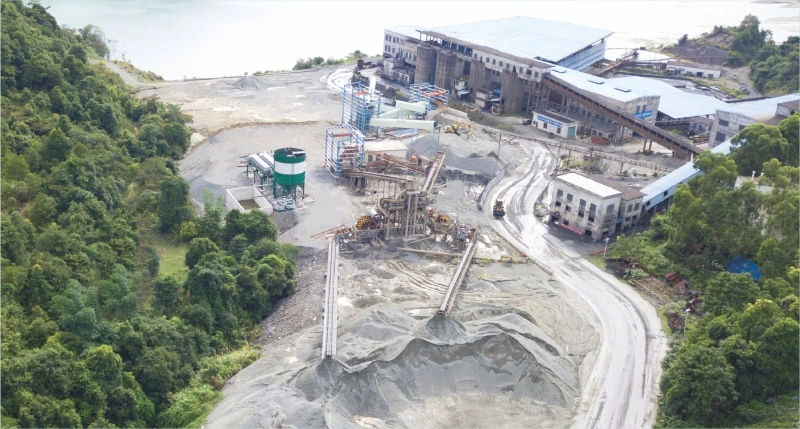
For decades, settling ponds have been the standard solution for handling wastewater and fine tailings generated by sand washing plants. The concept is simple: allow suspended solids to settle naturally, recover part of the water, and store the accumulated sludge in large ponds.
However, as environmental regulations become stricter and water resources become increasingly valuable, many sand washing operators are discovering that traditional settling ponds are no longer the most efficient option. Across regions such as North America, Australia, the Middle East, Africa, and Southeast Asia, more sand washing plants are adopting mechanical dewatering systems and replacing large settling ponds with high-capacity belt filter presses.
The shift is being driven by three major factors: land use, water recovery, and operating costs.
The Limitations of Traditional Settling Ponds
Settling ponds appear inexpensive at first because they require relatively little equipment. However, their hidden costs often become significant over time.
A typical sand washing plant can generate hundreds or even thousands of cubic meters of wastewater every day. As fine particles accumulate, settling ponds gradually lose storage capacity and require periodic dredging.
Common challenges include:
- Large land requirements
- Reduced water recovery efficiency
- Sludge accumulation
- Environmental compliance risks
- High maintenance costs
- Difficult sludge handling and disposal
In many regions, obtaining permits for new settling ponds has become increasingly difficult. Land prices continue to rise, while environmental authorities are demanding better wastewater management practices.
As a result, sand producers are looking for more compact and efficient alternatives.
Why Water Recovery Matters More Than Ever
Water has become one of the most valuable resources in aggregate and sand processing operations.
In regions facing water shortages, such as Australia, the Middle East, and parts of the United States, operators can no longer afford to lose large volumes of process water in tailings ponds.
Modern sand washing plants are increasingly focused on:
- Reducing freshwater consumption
- Recycling process water
- Lowering water procurement costs
- Meeting environmental regulations
A well-designed sand washing water recycling system can recover a substantial portion of process water and significantly reduce overall operating expenses.
Mechanical dewatering technologies play a critical role in achieving these goals.
How Belt Filter Presses Improve Sand Washing Tailings Dewatering
Unlike settling ponds, a belt filter press for sand washing plants continuously separates solids from wastewater.
The process typically involves:
- Thickened slurry enters the dewatering system.
- Flocculants improve particle aggregation.
- Gravity drainage removes free water.
- Progressive pressure zones squeeze additional moisture from the material.
- Dewatered cake is discharged continuously.
The recovered water can be returned directly to the washing process.
Compared with settling ponds, this approach offers several advantages:
Reduced Land Requirements
A large settling pond may occupy several hectares of valuable land.
An industrial belt filter press system requires only a fraction of that footprint.
For operators facing land constraints, this benefit alone can justify the investment.
Higher Water Recovery Rates
A modern sand washing tailings dewatering system can recover a large percentage of process water, helping reduce freshwater demand and improving sustainability.
Continuous Operation
Unlike filter presses that operate in batch cycles, belt filter presses provide continuous operation.
This makes them particularly suitable for high-capacity sand washing facilities that run around the clock.
Lower Labor Requirements
Automated operation reduces manual intervention and minimizes labor costs.
Why Large Sand Washing Plants Need High-Capacity Equipment
Many sand washing facilities have expanded significantly over the past decade.
A plant producing thousands of tons of washed sand per day can generate substantial volumes of fine tailings slurry.
Traditional dewatering equipment may struggle to handle such throughput efficiently.
This is where ultra-large mining belt filter presses provide a significant advantage.
The Advantages of Meibang’s Ultra-Large Mining Belt Filter Press
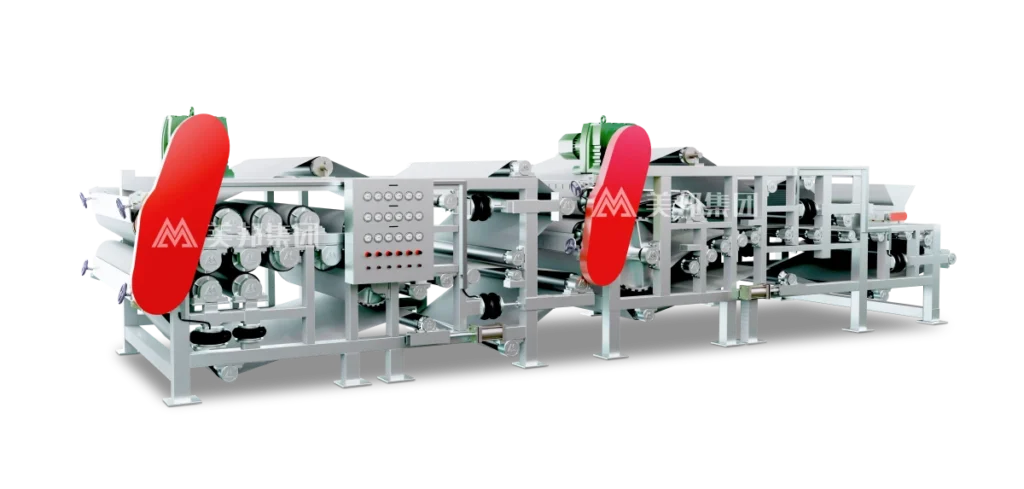
Meibang has developed an ultra-large dual-motor belt filter press specifically for demanding applications such as:
- Sand washing tailings
- Silica sand processing
- Mining tailings dewatering
- Coal slurry treatment
- Kaolin washing tailings
- Iron ore tailings
- Copper tailings
Unlike conventional belt filter presses, Meibang’s mining series is engineered for large-scale continuous operation.
Extra-Large Processing Capacity
The machine features:
- Equipment length up to 18 meters
- Belt width up to 3.5 meters
- Slurry treatment capacity up to 80 m³/h
This high throughput allows operators to process large volumes of tailings using fewer machines.
Dual-Motor Drive System
The dual-motor design provides:
- Improved torque distribution
- More stable operation
- Enhanced reliability
- Better performance under heavy loads
For large sand washing plants, operational stability is essential for maintaining production targets.
Optimized Dewatering Performance
The advanced multi-zone pressing design improves solid-liquid separation and helps reduce cake moisture compared with conventional belt press systems.
Lower moisture content means:
- Easier handling
- Lower transportation costs
- Reduced disposal expenses
Lower Energy Consumption
Compared with many alternative dewatering technologies, large belt filter presses can offer lower energy consumption while maintaining continuous throughput.
This becomes increasingly important as electricity costs continue to rise worldwide.
From Settling Pond Management to Modern Tailings Handling
The trend is clear.
The industry is moving away from simply storing tailings and toward actively managing and dewatering them.
Today, leading sand producers are focusing on:
- Tailings reduction
- Water recycling
- Land conservation
- Environmental compliance
- Operating cost reduction
A modern belt filter press for mining tailings allows operators to transform wastewater management from an environmental challenge into an efficient and controlled process.
Conclusion
As water scarcity, environmental regulations, and land costs continue to increase, traditional settling ponds are becoming less attractive for many sand washing operations.
Mechanical dewatering technologies offer a practical alternative that improves water recovery, reduces land requirements, and simplifies tailings management.
For high-capacity facilities seeking a reliable sand washing tailings dewatering solution, Meibang’s ultra-large dual-motor mining belt filter press provides continuous operation, exceptional processing capacity, and lower operating costs.
As more operators pursue efficient water recycling and dry tailings disposal strategies, belt filter presses are becoming a key component of the modern sand washing plant.