
For many iron ore producers, tailings management has become one of the fastest-growing operating expenses. While mining companies often focus on ore recovery rates, production efficiency, and equipment utilization, the cost of handling tailings can quietly consume a significant portion of the operating budget.
Tailings ponds require land, water, maintenance, and long-term environmental management. As regulations become stricter and water resources become more valuable, mines are under increasing pressure to find more efficient ways to manage tailings.
Today, more operators are evaluating high-capacity belt filter presses as a practical solution for reducing iron ore tailings disposal costs while improving water recovery and supporting dry stack tailings strategies.
The Real Cost of Iron Ore Tailings Management
Every ton of iron ore processed generates a certain volume of tailings. At large operations, this can translate into thousands of tons of tailings every day.
The challenge is not simply where to place the material. The challenge is how much water remains trapped inside it.
Wet tailings create several hidden costs:
- Larger storage facilities
- Higher pumping requirements
- Increased environmental monitoring
- Water losses through evaporation
- Additional reclamation expenses
- Higher transportation costs
Many mines underestimate how much of their tailings management budget is actually related to water rather than solids.
The more water that remains in the tailings stream, the more expensive disposal becomes.
Why Water Recovery Is Now a Financial Issue
Historically, water was often treated as an inexpensive resource. In many mining regions, that assumption is no longer valid.
Water scarcity is becoming a major challenge in regions where iron ore mining is expanding. Mines must often compete with agriculture, industry, and local communities for available water resources.
As a result, every cubic meter of recovered process water has economic value.
A modern iron ore tailings dewatering system does more than produce a filter cake. It also returns valuable water back to the processing plant.
Recovered water can be reused in:
- Grinding circuits
- Classification systems
- Ore washing operations
- Dust suppression systems
Reducing freshwater demand can create substantial long-term savings for large mining operations.
The Limitations of Conventional Tailings Ponds
Tailings ponds remain common throughout the mining industry. However, they present several operational disadvantages.
Increasing Land Requirements
As production expands, tailings facilities must also expand.
New storage areas require:
- Land acquisition
- Engineering studies
- Regulatory approvals
- Ongoing maintenance
These investments can become increasingly difficult and expensive over the life of a mine.
Water Losses
Large surface areas lead to significant evaporation losses, especially in hot and dry climates.
The water trapped inside tailings ponds often remains unavailable for immediate reuse.
Long-Term Environmental Liability
Even after a mine closes, operators may remain responsible for monitoring and maintaining tailings facilities for years.
These long-term obligations add hidden costs that are often overlooked during project planning.
Why More Mines Are Considering Mechanical Dewatering
Mechanical dewatering allows mines to remove a substantial amount of water before tailings reach the storage area.
Instead of pumping dilute slurry into a pond, the material is converted into a stackable filter cake.
The advantages are clear:
- Reduced storage volume
- Increased water recovery
- Lower pumping requirements
- Improved site safety
- Reduced environmental footprint
For many operators, the economics become increasingly attractive as water costs and environmental compliance costs continue to rise.
The Role of Belt Filter Presses in Tailings Dewatering
Several technologies can be used for tailings filtration, including vacuum filters, ceramic filters, and plate and frame filter presses.
However, large-scale iron ore operations often prioritize throughput and operating efficiency.
This is where belt filter presses for iron ore tailings offer a compelling advantage.
Because the process is continuous, large volumes of slurry can be treated without the interruptions associated with batch-operated filtration systems.
Continuous operation is particularly valuable when handling the massive tailings volumes generated by modern beneficiation plants.
Lower Cost per Ton of Tailings Processed
For mining companies, equipment selection is rarely based solely on moisture content.
More often, the critical question is:
What is the total cost of processing each ton of tailings?
High-capacity belt filter presses help reduce this figure by offering:
- Continuous production
- Lower energy consumption
- Reduced labor requirements
- Simplified maintenance
- High throughput capacity
These factors can significantly lower operating costs over the life of the equipment.
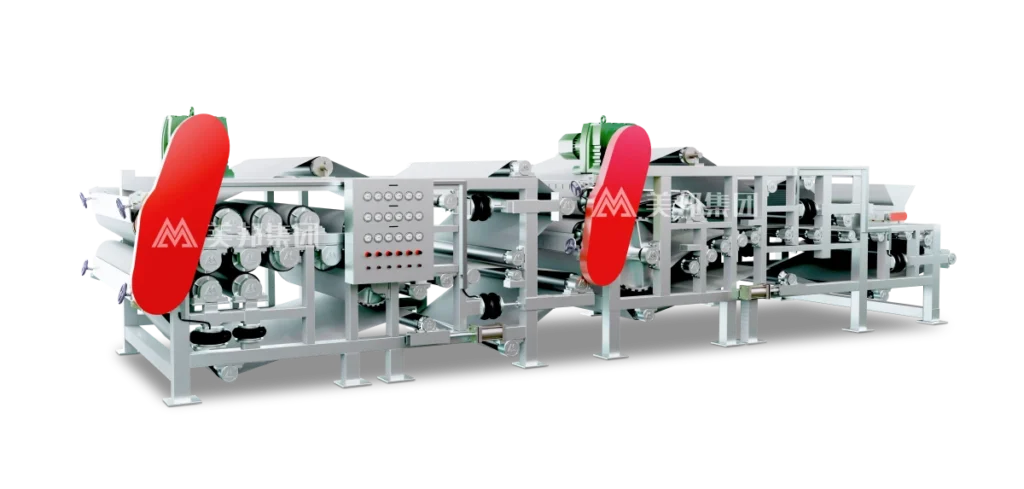
Meibang Ultra-Large Dual-Motor Belt Filter Press
Large mining operations require equipment capable of processing substantial slurry volumes without becoming a production bottleneck.
To meet these demands, Meibang has developed an ultra-large dual-motor belt filter press specifically for mining and tailings dewatering applications.
The system is widely suitable for:
- Iron ore tailings
- Copper tailings
- Nickel tailings
- Kaolin washing tailings
- Sand washing tailings
- Mineral processing wastewater
Built for High Throughput
The machine features:
- Belt widths up to 3.5 meters
- Equipment length up to 18 meters
- Slurry treatment capacity up to 80 m³/h
The large filtration area allows operators to process more material using fewer machines.
This helps reduce both capital investment and operating expenses.
Reliable Dual-Motor Drive System
Mining operations often run continuously for extended periods.
The dual-motor drive system provides:
- Stable power delivery
- Improved operational reliability
- Better load distribution
- Enhanced durability
This design supports long-term operation under demanding mining conditions.
Reduced Energy Consumption
Energy efficiency remains an important consideration for every mine.
Compared with many alternative filtration technologies, belt filter presses can achieve high throughput with relatively low power consumption.
For operations running around the clock, these savings can become substantial over time.
Supporting Dry Stack Tailings Strategies
Many mining companies are moving toward dry stack tailings systems to reduce environmental risk and improve sustainability.
A high-capacity belt filter press plays a critical role in this transition.
By removing water before disposal, operators can:
- Reduce dependence on large tailings ponds
- Improve storage stability
- Simplify reclamation planning
- Recover more process water
As dry stacking becomes more common, efficient dewatering equipment will continue to play an increasingly important role in mine design.
Conclusion
Reducing iron ore tailings disposal costs requires more than simply increasing storage capacity. The most effective strategy is to remove water from the tailings stream as early as possible and return that water to production.
High-capacity belt filter presses help mines achieve this goal by combining continuous operation, efficient water recovery, and lower operating costs.
For large-scale iron ore processing facilities, Meibang’s ultra-large dual-motor belt filter press provides a practical solution for improving tailings management, reducing disposal expenses, and supporting modern dry stack tailings operations.